
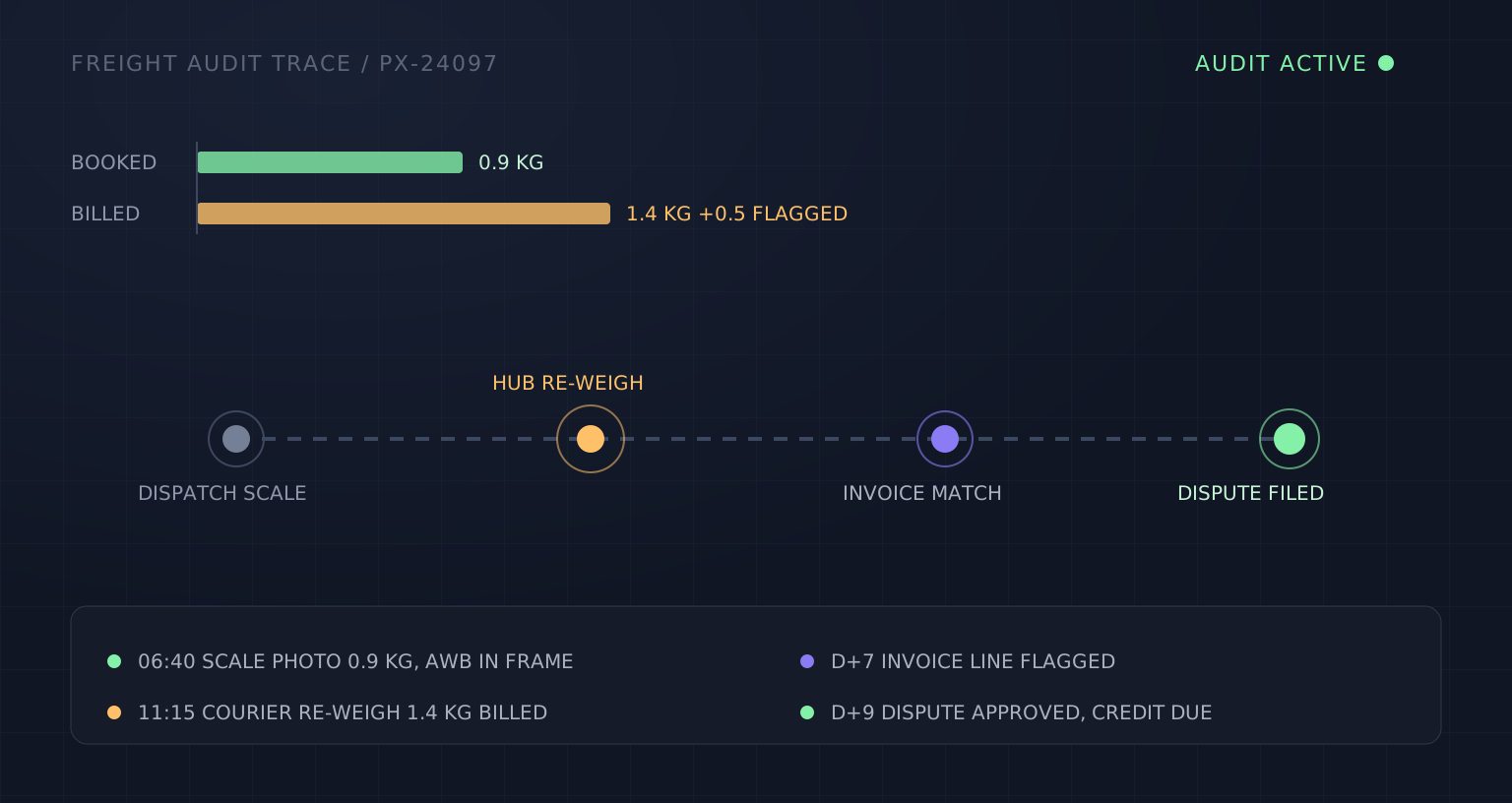
Every parcel you ship carries two weights. The first is the one you booked: what your packer recorded at the dispatch table. The second is the one the courier billed: what their system charged you for. When the second number is higher than the first, you have a courier weight discrepancy, and you are paying freight on weight that may never have existed. It does not appear as a crisis. It appears as a freight bill that is always a little higher than it should be, month after month.
The size of it is worth calculating once for your own network. Consider a mid-size D2C brand shipping 3,000 parcels a day out of a Faridabad warehouse. If 5-8% of parcels come back billed heavier than booked, that is 150-240 parcels a day. At a typical overcharge of ₹10-₹15 per parcel, the leak is ₹55,000-₹80,000 a month. During the festive season, when parcel volume doubles and hub re-weighs get stricter, it roughly doubles too. Most brands never see this number, because it is spread across tens of thousands of invoice lines and freight is usually reviewed in aggregate.
How the gap between booked and billed weight appears
Four mechanisms create most courier weight discrepancies. None of them requires bad faith. All of them cost money when nobody checks.
- Courier re-weighs. The hub re-measures the parcel and the courier’s figure replaces yours. Their scale is the contract authority. If your scale drifted, or the parcel picked up moisture in the monsoon, or the hub scale simply reads differently, the billed weight moves up and stays there.
- Slab rounding. Couriers bill in slabs, usually 500 grams. A parcel at 1.02 kg bills at 1.5 kg. A parcel at 0.51 kg bills at 1 kg. Rounding itself is legitimate, but it punishes anything that drifts just past a slab boundary, and it makes small weighing errors expensive.
- Volumetric weight. Light, bulky parcels bill on dimensional (DIM) weight: length × breadth × height divided by a divisor, commonly 5,000 for surface shipments. A 400-gram hoodie in a generous box can bill at 2 kg. If the courier measures the box larger than you did, or applies a different divisor than your rate card says, the DIM weight climbs and the charge follows.
- Packaging drift. Packers add filler, upgrade cartons, tape heavily before the festive rush. The parcel that shipped at 0.9 kg in June ships at 1.1 kg in October, and nobody updates the master data the booking weight comes from.
What the leak actually costs
Run the numbers on one brand, illustratively. A footwear seller shipping 3,000 parcels a day between Delhi, Bengaluru and Guwahati. Four percent of parcels get re-weighed up at the hub, average gap ₹12 a parcel: ₹43,000 a month. Slab rounding on parcels sitting just over the boundary adds another ₹8,000-₹10,000. DIM misapplication on one bulky SKU adds ₹6,000 more. Total: roughly ₹60,000 a month, or about 1.5-2% of the freight bill. Not enough to trigger an alarm. Enough to matter on a thin margin.
The leak stays invisible for a structural reason. Freight is reviewed as a monthly total against budget. A 2% overshoot reads as fuel surcharge, zone mix, or festive-season rate cards. Nobody opens the invoice file and compares 90,000 billed weights against 90,000 booked weights. That comparison is one part of a complete courier invoice reconciliation and freight audit, which also checks zones, duplicate charges and COD remittance. It is where the recoverable money sits.
How to audit courier invoices
A working audit has five steps. The first two are about evidence, and they decide everything that follows.
- Capture dispatch evidence. A calibrated digital scale at the dispatch table, and a photo of each parcel on the scale with the AWB label visible in frame. For bulky SKUs, a photo against a marked dimension board. This feels tedious until the first dispute, when it is the only thing the courier accepts.
- Match invoice lines to booking data. Every AWB, every month: booked weight, billed weight, zone, rate-card slab, amount charged versus amount expected. The match is mechanical. The volume is the problem.
- Flag the mismatches. Billed above booked by more than a small tolerance, DIM divisor different from the rate card, wrong zone applied, slab jumps with no re-weigh event. Each flag gets a reason code, because disputes without reasons get rejected.
- File disputes inside the window. Delhivery, Xpressbees, Ekart, Blue Dart and the others all accept weight disputes, but the window is short, typically 7-15 days from invoice. Past the window, the line is closed and the money is gone.
- Track the recovery. Disputes resolve as credit notes against future invoices, not refunds. Someone has to confirm the credit actually appeared, or “recovered” stays a spreadsheet claim.
Brands that run this properly commonly recover 50-70% of flagged overcharges. On the illustrative ₹60,000 a month above, that is ₹30,000-₹42,000 back, every month, for evidence work rather than negotiation.
Why manual audits die at scale
The five steps work beautifully at 300 parcels a day. One person, one spreadsheet, a folder of scale photos. At 3,000 parcels a day the same process needs 90,000 line matches a month, and it breaks in predictable places. The photos stop getting taken when the dispatch table is busy. The matching falls a week behind, then two. The dispute window closes on last month’s flags while this month’s invoice is still being keyed in. During the festive season the auditor gets pulled into ops, and the audit quietly pauses for the two months when the overcharging is at its worst.
The common fallback is sampling: check 10% of lines, dispute what you find. Sampling caps your recovery at 10% of the recoverable amount, and couriers notice which lanes and slabs you never check. Courier overcharging does not have to be deliberate to follow the path of least resistance.
Where a checking agent fits
Notice that nothing in the audit is judgment-heavy. Read an invoice line, match it to a booking, apply a rule, build an evidence pack, file it before a deadline, confirm the credit. It is exactly the kind of structured, high-volume, unforgiving-of-delay work that people do badly at scale and checking agents do well. The rollout follows the same phased-trust pattern as any other operations process.
First, Shadow mode. The agent reads invoices and booking data and flags mismatches, but files nothing. Its flags are scored against what a human auditor would have caught, for weeks, until the accuracy is proven per category. Then human-in-the-loop: the agent prepares each dispute pack — the scale photo, the invoice line, the rate-card extract, a draft dispute with the reason code — and a person approves every filing. Categories that stay accurate, like slab-rounding errors with a clean photo, graduate to autopilot: filed automatically below a rupee threshold, inside the window, every time. High-value disputes and anything ambiguous stay with people permanently.
What changes is coverage and timing, not judgment. Every line gets checked instead of a sample. Disputes go out on day one instead of day twelve. Credits are confirmed instead of assumed. On the illustrative brand above, moving from a sampled manual audit to full coverage typically lifts recovery from ₹15,000-₹20,000 a month to ₹35,000-₹45,000 — the same leak, actually chased.
What this does not fix
An audit cannot dispute what you cannot evidence. If your dispatch scale is uncalibrated, or your SKU master data is stale, or nobody photographs the parcel, the courier’s re-weigh stands and the audit mostly confirms you were undercharging yourself. Evidence discipline is an ops habit, and it has to exist before any software helps.
It also cannot renegotiate your rate card. If the DIM divisor, the slab structure or the base rates are the real problem, that is a contract conversation at renewal, informed by the audit data but not settled by it. And re-weighs that are genuinely correct — the festive-season carton that really did get heavier — will stand. The point of a freight audit is to pay for the weight you actually shipped. Not less.
Courier weight discrepancy is a boring leak, which is why it survives. Capture evidence at dispatch, match every line, dispute inside the window, and keep the judgment calls with people. The money is already yours. The audit is just how you ask for it back.
RTO is the other leak worth sizing the same way. The RTO cost calculator turns your orders, COD share and RTO rate into the monthly number in about ten seconds.