
Ask a D2C founder what customer support costs and you usually get the salary bill. Ask what a single ticket costs and the room goes quiet. That second number is the one that matters, because it is the only way to compare hiring, outsourcing and ecommerce support automation on the same scale. D2C customer support cost in India is lower than in Western markets, but it is not low. Once you count agent time, tools, management and attrition honestly, the true cost per ticket is two to three times the figure most teams carry in their head.
Consider a mid-size brand shipping 9,000 orders a month out of Bengaluru and Delhi NCR. A typical ticket rate for a COD-heavy brand is 8-12% of orders, so the team is handling roughly 900-1,100 tickets a month. That is 35-40 conversations a day, and the festive season comfortably doubles it. If the founder thinks support costs “two agents at ₹25,000,” the real ledger below will be a surprise.
Work out the real cost per ticket
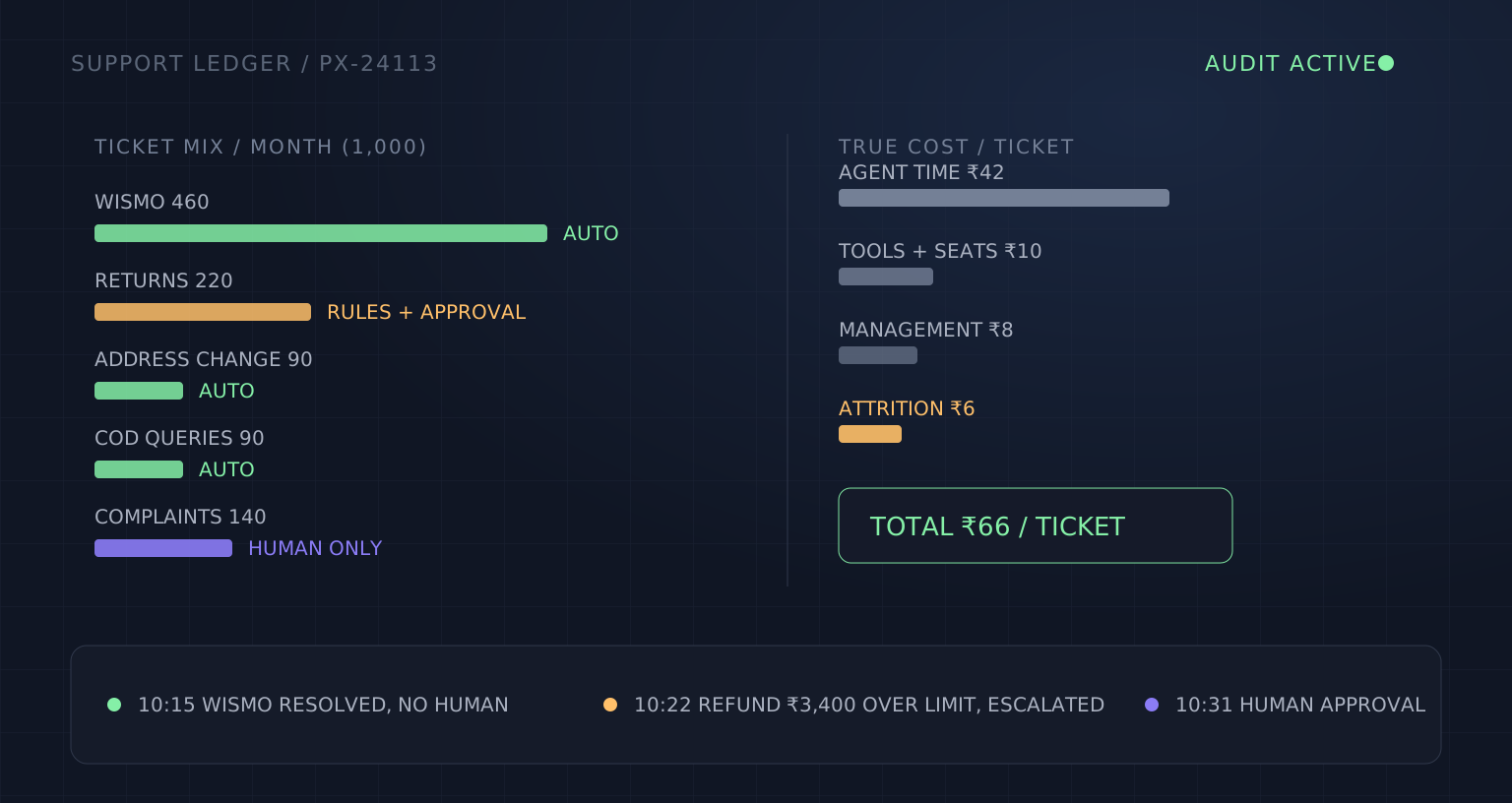
The cost per ticket has four layers. The first is agent time. One support agent on WhatsApp and email closes 40-50 simple tickets a day, fewer when the queue has complaints in it. On a ₹25,000 salary, plus seat, space and statutory costs, that agent is fully loaded at roughly ₹35,000-₹40,000 a month. At 900 tickets a month across two agents, agent time alone is about ₹40-₹45 per ticket.
The second layer is tools. A helpdesk seat runs ₹1,500-₹4,000 per agent per month. The WhatsApp Business API charges per conversation, and utility templates are not free. Add the order-management and courier-tracking logins the team flips between, and tools commonly add ₹8-₹12 per ticket.
The third layer is management. A team lead reviewing escalations, someone doing quality checks, and the founder’s own hours approving refunds. Spread across the queue, this is usually another 15-25% on top of agent cost, so call it ₹7-₹10 per ticket.
The fourth layer is the one everyone skips: attrition and retraining. Indian support teams routinely see 30-40% annual attrition, and it peaks right after the festive season, exactly when you can least afford it. Every exit costs recruitment fees, three to six weeks of training, and a month where the new agent works at half speed while a senior answers their questions. Costed honestly, churn adds another ₹5-₹8 to every ticket the team ever closes. Add the four layers and this brand’s true cost per ticket is not ₹25. It is ₹60-₹75.
What is actually in the queue
Before automating anything, split a month of tickets by category. For most Indian D2C brands the mix looks like this:
- WISMO (“where is my order”), 40-55%. The answer already exists in Delhivery, Xpressbees, Ekart or Blue Dart tracking. The customer just cannot see it, or does not trust the tracking page. Fully automatable, because the work is retrieval and a clear reply, not judgment.
- Returns and refund status, 15-25%. Partly automatable. A return inside the policy window, below a rupee limit, with pickup available at the pin code, is a rules problem. A damaged-goods dispute is not.
- Address and order changes, 5-10%. Automatable with one hard check: has the parcel shipped yet? Before dispatch, the change is free. After the NDR first attempt, it becomes a courier problem with a clock on it.
- COD and payment queries, 5-10%. Confirmations, prepaid nudges, refund-to-bank-account timing. Mostly automatable on WhatsApp, where the customer already is.
- Complaints, 10-15%. Late delivery, wrong item, damaged parcel, rude rider. These carry the brand’s reputation and they stay with people. Permanently.
The pattern: two-thirds to three-quarters of the queue is retrieval and rules. The rest is judgment. That split decides what automation can take, and no vendor pitch changes it.
Resolved and deflected are not the same number
Most support automation is sold on deflection rate: the share of tickets the bot “handled” without a human. Deflection is easy to inflate. A bot that replies “your order is on the way” to a customer whose parcel has been stuck at a Bhiwandi hub for four days has deflected the ticket. It has not resolved anything, and the customer will be back within 48 hours, angrier, on a channel that costs more.
The honest metric is cost per resolved conversation: total support cost divided by conversations closed with no repeat contact inside 72 hours. Run the arithmetic on a deflection-heavy tool and the savings shrink. If a bot deflects 60% of WISMO tickets but a third of those customers come back, the true resolution rate is 40%, and every repeat contact now costs double — the bot touch plus the human touch, with a worse customer experience attached.
Deflection that angers customers is not savings. It is deferred cost with interest. Any automation you evaluate should report repeat-contact rate next to the deflection number, or you are reading the marketing version of your own ledger.
Build or buy, honestly
Building in-house means hiring engineers to integrate courier tracking APIs, and each courier is its own project — Delhivery’s status codes do not match Xpressbees’, Ekart’s NDR reasons differ from Blue Dart’s. It means managing WhatsApp Business API templates, consent flows and DPDP Act obligations. And it means owning the system through the Diwali spike, when ticket volume doubles and your two engineers are also the people keeping checkout alive. Building is a product decision. It makes sense when support logic is your competitive edge, which for most D2C brands it is not.
Buying a generic chatbot is a deflection decision. AI-agent pricing can be per seat, resolution, order or outcome, and each model scales differently with your volume. Generic flows do not know your COD policy or your courier allocation rules, and you are back to the repeat-contact problem above. The middle path is an agent service that works inside your existing tools, takes the retrieval-and-rules categories, and escalates the rest. That is an outcomes decision, and it should be priced and judged on cost per resolved conversation, not on features.
Where an agent with human escalation lands
Here is what this looks like on a real morning for the brand above. 10:15, a WhatsApp WISMO arrives from a customer in Pune. The agent pulls live tracking from Xpressbees, sees the parcel is out for delivery, and replies with the expected window and the rider’s contact option. Resolved in under two minutes, no human touched it. 10:22, a refund request for ₹3,400 arrives, above the ₹1,500 auto-approval limit the founders set. The agent assembles the order history, the return pickup status and the policy clause, and routes it to a human with a one-line recommendation. 10:31, the founder approves from her phone. The customer gets a same-morning answer, and the refund decision stayed with a person.
In this scenario the routine categories — WISMO, address changes before dispatch, COD confirmations, in-policy returns — close without agent time, and the cost per resolved conversation on those categories drops by half or more. The two support agents stop copy-pasting tracking links and spend their hours on complaints, where judgment actually changes the outcome. Headcount stays the same. The festive-season doubling is absorbed by the queue, not by emergency hiring in October.
The trust model matters as much as the cost math. Start with the agent suggesting replies that humans send (Shadow mode). Move categories that stay accurate to human-approved sends. Let only the proven, low-risk ones run automatically within agreed limits — and keep refunds, complaints and anything reputational behind a person.
What this does not fix
Automation handles the queue you have. It does not shrink the queue. If your WISMO volume is high because your delivery promise is unrealistic, or because one courier lane between Delhi and Jaipur fails every week, the fix is upstream — promise dates, courier allocation, packaging — not a faster reply. A faster “it is coming” to a customer you are failing is the deflection trap with better grammar.
It also does not repair policy problems. A returns policy customers find unfair generates tickets no agent can close politely. And it does not make complaint handling cheap: the 10-15% of the queue that carries your brand still needs people, still needs training, and still churns if the work is miserable. What changes is that those people spend their day on work that needs them, at a cost per resolved conversation you can finally see.
Do the ledger once, with your own numbers. Split the queue by category. Automate the retrieval and rules behind approval, keep judgment with people, and measure resolution instead of deflection. It is not exciting. It is how support stops being a cost that grows with every order you ship.