
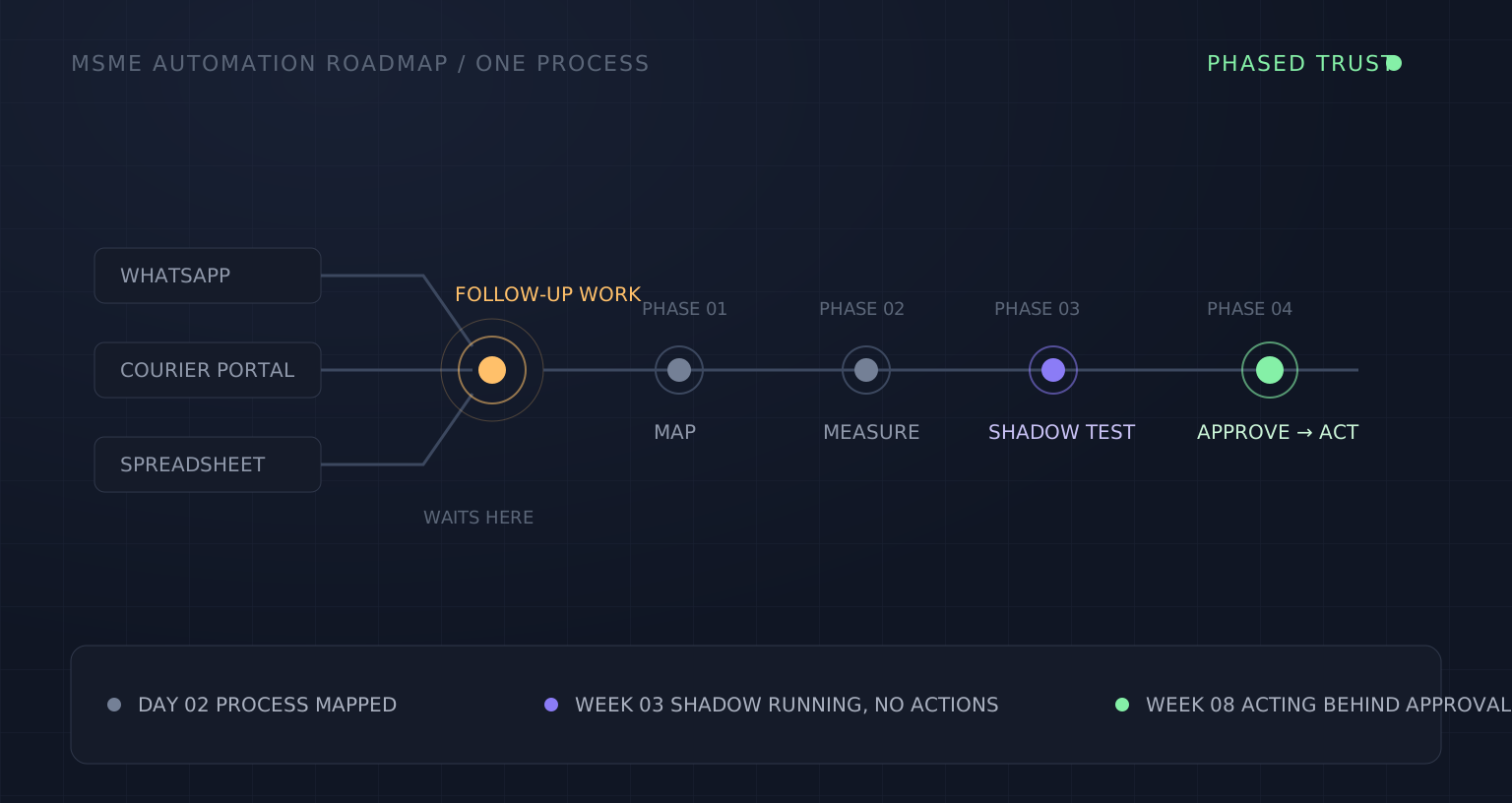
If you run operations at an Indian MSME, the pitch you hear most often is a chatbot for your website. It is usually the wrong place to start. Your website is not where the hours go. The hours go into the follow-up work between your systems: the WhatsApp thread with a customer asking where her order is, the Delhivery or Xpressbees portal someone has to check by hand, the spreadsheet that reconciles cash-on-delivery (COD) remittances against the bank statement, the group chat where your team chases a courier that missed a pickup in Faridabad. None of this shows up in a demo. All of it eats your day.
This is a guide to starting AI for small business India the boring, safe way. It assumes you have between ten and two hundred people, at least one process that runs on WhatsApp plus spreadsheets, and no appetite for a failed six-month software project. It follows one principle: diagnose the process before you automate anything, because most AI projects in businesses your size stall when someone buys a tool before mapping the work.
Start with the follow-up work, not the website
Look at where your team’s hours actually go on a normal Tuesday. In most Indian MSMEs that ship physical goods, the answer is not selling or making. It is the connective tissue. Confirming a COD order on WhatsApp before it ships. Checking a courier portal when a parcel shows no scan between Jaipur and Lucknow. Answering “where is my order” messages that already have an answer sitting in a system the customer cannot see. Copying weight and freight figures from a courier invoice into a spreadsheet to check whether the billed weight matches what you packed.
This work has three properties that make it the right starting point for AI automation in an Indian MSME. It is repetitive, so a suggestion made today will be needed again tomorrow. It is measurable, so you can say in minutes and rupees what it costs now. And it lives between systems, which is exactly where people get tired and things fall through. A website chatbot sits at the edge of the business and mostly answers questions nobody measured.
Pick one process that hurts and can be counted
The first process you choose decides whether the whole effort lives or dies. Choose wrong and you get a stalled project. Choose well and you get a small, boring win that funds the next one. A good first process has four traits.
- It hurts every week. Not once a quarter. Weekly pain means weekly proof. NDR follow-ups on failed deliveries, COD confirmation, and “where is my order” replies all qualify for a business shipping a few hundred orders a day.
- You can count it today. Hours spent, orders affected, rupees lost. If you cannot put a rough number on it before you start, you will never know whether anything improved.
- It has a clear “done.” The customer got a delivery date. The RTO was avoided. The invoice discrepancy was flagged. A process without a finish line cannot be tested.
- Mistakes are recoverable. A wrong WhatsApp update can be corrected. A wrong refund to a vendor or a wrong GST filing is a bad place to learn. Keep finance and compliance out of round one.
Consider an illustrative example: a mid-size D2C brand in Surat shipping 300 orders a day, 60% COD. The team spends roughly three hours a day on COD confirmation messages and another two on delivery-status replies. That is 25-30 staff-hours a week on two valid candidates. Pick the one with the bigger number, not the one that sounds more impressive.
Map where the work waits
Before any tool enters the picture, map the chosen process as it actually runs. Not the version in the process document. The real one, with the delays in it. For a failed delivery, the map might read: NDR appears in the courier portal at 11:00, nobody checks the portal until 16:00, the message to the customer goes out the next morning, the customer has already refused the parcel by then. The automation opportunity is rarely “send the message.” It is the five hours the case waited for someone to notice it.
Draw it on one page. Every handoff, every wait, every place where the answer exists in one system while a person is looking for it in another. This page is the most valuable artefact of the entire exercise, because it tells you whether you need AI at all. Sometimes the fix is a shared dashboard and a changed shift pattern. You spent days, not lakhs, finding it out.
Test suggestions without letting them act
Once the map exists and the process is measured, you can bring in a system. The first mode is shadow. The system reads the same events your team sees: new NDR entries, unscanned parcels, unread customer messages. It drafts what it would do: this message to this customer, this re-attempt request to the courier, this escalation to the ops lead. And it does nothing. Every suggestion is scored against what your team actually did and how it turned out.
This phase answers the only question that matters before money moves: is it right often enough? Set the bar before testing starts, in writing. For routine COD confirmations you might demand 98% agreement with your team over two weeks. For anything touching refunds, the bar should be higher and the timeline longer. Two to four weeks of shadow running on real volume tells you far more than any demo environment will.
Approve first, automate only what proves safe
When a suggestion category clears its bar, it graduates one step, not all the way. A person now reviews a queue of drafted actions and approves them, one tap each, with the evidence attached. The system acts only behind that approval. This is where the time saving actually starts: the drafting, checking and chasing are done, and your team’s judgment is applied at ten seconds per case instead of ten minutes.
Categories that stay accurate week after week behind approval can move to running automatically within limits your supervisors set: only these pin codes, only orders under ₹2,000, only these message templates, escalate anything unusual. Complex cases stay with people permanently. The point of the ladder (shadow, then approval, then limited autopilot) is that trust is earned per category, with numbers, and can be revoked the week accuracy slips. Festive season is the natural test: when Diwali volume doubles, the categories on autopilot carry the load, and the approval queue absorbs the rest without new headcount.
Budgets and timelines, honestly
Realistic numbers for an MSME doing this properly. The diagnostic mapping of one process takes days, not months: a focused two-day review can produce the map, the measurements, and a go/no-go recommendation. Shadow testing runs two to four weeks depending on volume. Approval-mode operation is where you should expect to sit for at least a month before anything runs unattended. Total elapsed time from start to first automated category: roughly six to ten weeks.
On cost, be suspicious of two extremes. The first is the ₹5,000-a-month “AI for everything” subscription that turns out to be a dashboard with a chat window. The second is the ₹15-lakh custom build quoted before anyone has looked at your process. A sane engagement sits in between: a fixed, modest fee for the diagnostic itself, then a monthly cost for the running system that should be visibly smaller than the staff-hours it replaces. If the arithmetic does not close on one page, walk away.
What to ignore
Three categories of pitch can be safely ignored while you are starting out. First, AI-washed dashboards: existing reporting tools with a summary box on top. They show you that follow-up work exists and change nothing about who does it. Second, demos where the agent books a flight or writes a poem. Your problem is a parcel waiting in Bhiwandi, not poetry. Third, any vendor who wants to automate before measuring. The sequence is always map, measure, shadow, approve, automate. A vendor who skips the first two steps is asking you to fund their learning.
What this does not fix
AI automation of the kind described here does not fix a broken underlying process. If your address capture is sloppy, your RTO will stay high no matter how good the follow-up is. If your courier allocation logic is wrong for your lanes, no message template fixes the delivery time. It also does not replace judgment. Anything involving disputes, money movement, compliance or an unusual customer commitment stays with your team, permanently.
And it does not work without the boring groundwork. If you will not spend two days mapping one process and two weeks measuring it, you are not short of AI. You are short of diagnosis, and no tool purchases its way around that. Start with one painful, countable process. Map where it waits. Test suggestions without acting. Automate what proves safe, behind approval, within limits you set. That is the whole method, and it is small enough to start this month.