
Every operations head in India has had this meeting. RTO is up, the finance team is asking about freight cost, and someone says: “Which courier should we actually be using?” The question assumes there is an answer. There is not. Ask a brand shipping apparel from Delhi and they will swear by one courier. Ask a brand shipping supplements from Mumbai and they will name a different one. Both are right, because they are shipping different products into different pin-code clusters with different COD shares.
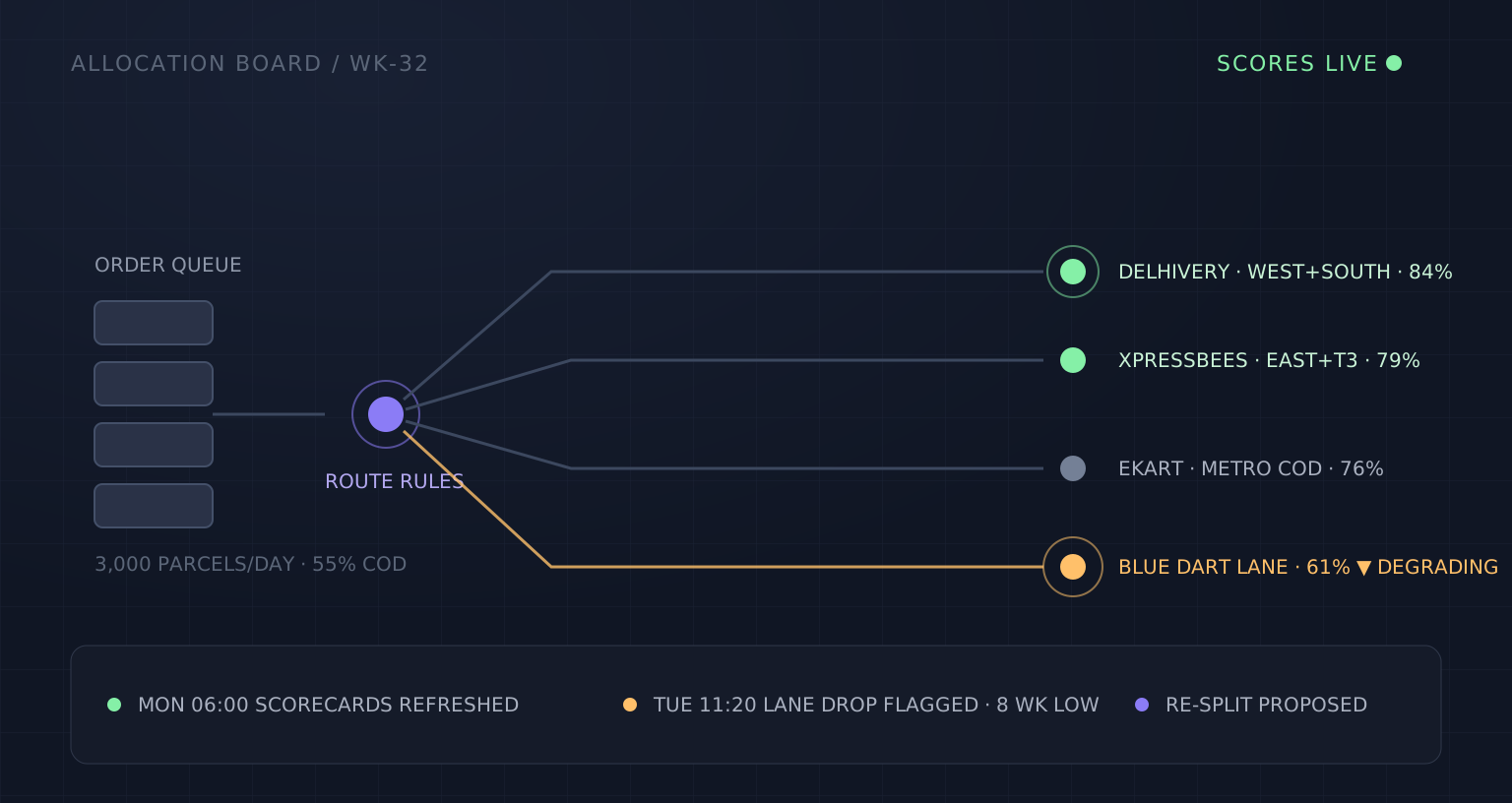
The useful question is not “which courier is best.” It is “which courier is best for which slice of my order book, this month.” Consider a mid-size D2C brand shipping 3,000 parcels a day, 55% COD. On its Delhi-to-metro lanes, Courier A delivers on first attempt 84% of the time. On its North-East and tier-3 clusters, the same courier drops to 61%, while Courier B, the one the team thinks of as the backup, holds 79%. A single-courier decision averages all of this away. The average is where the RTO lives.
Why there is no best courier for ecommerce in India
Courier performance in India is local in a way that rate cards do not capture. A courier’s first-attempt delivery rate is the output of its delivery franchise density in that specific pin-code cluster, the quality of the local hub, and how it treats your category. The same network behaves differently for a 200-gram prepaid parcel going to Bengaluru and a 2.5 kg COD parcel going to Patna.
Three variables drive most of the difference. The first is geography: national couriers like Delhivery, Xpressbees, Ekart and Blue Dart each have clusters where they are structurally strong and clusters where they rely on stretched franchise partners. The second is category: a courier that handles apparel well may mangle a fragile or heavy category, and its weight-audit behaviour changes with it. The third is COD share: couriers manage COD routes differently because remittance and fake-refusal risk sit on their books too. A lane that is fine at 20% COD can degrade badly at 60%.
This is why courier selection decks full of national averages are decoration. The only number that matters is performance on your order book, by cluster, over the last eight weeks.
The evaluation criteria that actually matter
When you evaluate a courier partner, or re-evaluate one you already use, six criteria carry almost all of the weight. Rate card is not on the list. Rate differences of ₹8-₹12 per parcel are real, but they are smaller than the RTO and NDR differences between a good lane and a bad one.
- First-attempt delivery rate, by pin-code cluster. Not the national figure the courier quotes. Pull your own data, grouped by destination cluster. Every failed first attempt starts the NDR clock, and every NDR is a potential RTO.
- NDR behaviour. How fast does the courier raise the NDR, how legible is the reason code, and does it act on your re-attempt instructions within the same day? Two couriers with identical delivery rates can differ by a full day here, and that day is your recovery window.
- RTO speed. When a return is unavoidable, how many days does the parcel take to come back? Slow RTO ties up inventory for two extra weeks and turns a recoverable item into a write-off during festive season.
- Weight-dispute fairness. How often does billed weight exceed your packed weight, and how painful is the dispute process? A courier that over-bills 4% of shipments and stonewalls every dispute is more expensive than its rate card says. A complete courier invoice reconciliation and freight audit answers this across weight, zone, duplicates and COD remittance, not just one disputed parcel.
- API and scan quality. Are scans timely and honest? A courier whose tracking events lag by six hours poisons your WISMO tickets, your NDR recovery, and any allocation logic you build on top.
- Festive capacity. What happened to this courier’s performance on your lanes last Diwali? Some networks hold up at 2.5x volume. Some quietly collapse in specific clusters and recover in January. Ask for last year’s numbers, not this year’s promises.
Score each courier you already use on these six, per cluster. The exercise takes a week of data pulling and usually produces two surprises: a courier that is worse than its reputation on your lanes, and a backup courier that is better than anyone realised.
Why serious brands run two to four couriers
Once the scorecards exist, the conclusion writes itself. If Courier A wins the West and South clusters and Courier B wins the East and tier-3 clusters, the right answer is not to pick one. It is to route each order to the courier that wins its cluster. A multi-courier allocation strategy turns that conclusion into rules by zone, weight, COD value and current lane performance. It is what most serious Indian ecommerce operations above roughly 1,000 parcels a day end up doing, whether they call it that or not.
The multi-courier setup also buys negotiating leverage and resilience. When one courier’s hub floods in the monsoon or its franchise partner in a region quits mid-December, volume shifts to the other lanes the same day. A single-courier brand in that situation is sending apology messages on WhatsApp for a week.
The cost is complexity. Three courier integrations, three pickup schedules, three weight-dispute processes, three remittance cycles. That cost is real, and it is the reason allocation needs rules rather than daily judgment calls from a logistics coordinator with a spreadsheet.
The hidden cost of allocation rules nobody maintains
Here is the part the vendor-selection conversation skips. Allocation rules decay. The rules were written when the scorecards were pulled, usually during a contract negotiation or a bad RTO quarter. Then reality moves. A courier degrades in one cluster for six weeks before anyone notices. A new product line launches at 3 kg and lands on a lane priced for 500 grams. COD share drifts up in the festive quarter and the rule that made sense in June is quietly expensive by October.
Most teams discover the decay through a symptom: RTO creeping up in a region, freight cost per delivered order rising, a finance query that takes three days to answer because the data lives in four courier portals. The fix in the moment is a manual override. Overrides accumulate. Within a year, the “allocation rules” are a spreadsheet, two people’s memory, and a set of exceptions nobody wrote down.
Counted honestly, maintaining allocation for a 3,000-parcel-a-day operation is typically 12-20 person-hours a week: pulling scorecards, comparing against the rules, updating splits, chasing disputes. It is unglamorous recurring work, so it is exactly the work that slips when the team is busy, which is always.
Where data-driven allocation with oversight fits
This is the shape of work that suits an agent with supervision. The inputs are already digital: courier APIs, scan events, delivery outcomes, weight bills. The judgment is bounded: given this week’s performance per cluster, propose the new split, flag anomalies, and draft the weight disputes. The decision stays with a person.
In practice it looks like this. The system reads delivery outcomes and freight bills continuously and maintains the scorecard per cluster, per courier, without anyone pulling reports. When a lane degrades past an agreed threshold, say first-attempt delivery drops five points week-on-week in a cluster, it proposes a re-allocation with the evidence attached, and a logistics lead approves or rejects it. Weight discrepancies above a set amount get drafted into disputes with the packing-station data already attached. Novel situations, a new category launch, a courier’s festive surcharges, escalate to the team rather than getting auto-decided.
The value is not that software picks couriers. It is that the scorecards never go stale, the decay gets caught in week one instead of quarter two, and the 12-20 hours of weekly maintenance shrink to a review session. The team keeps the decisions. It stops doing the data janitor work underneath them.
What this does not fix
Allocation cannot rescue a bad lane. If every courier you have access to is weak in a cluster, splitting volume among them just distributes the damage. Sometimes the honest answer is a regional courier you do not yet work with, or accepting slower delivery promises on that cluster and setting customer expectations on WhatsApp at checkout.
It also cannot fix upstream problems that look like courier problems. Incomplete addresses, wrong phone numbers and unconfirmed COD orders produce NDRs no courier can deliver through. If your confirmation and address hygiene are weak, fix those first; the scorecard will thank you.
And automated proposals are only as good as the data underneath. Couriers with late or dishonest scans distort every scorecard built on them, which is why API and scan quality is an evaluation criterion and not an afterthought. Choosing a courier partner in India was never a one-time procurement decision. It is a standing measurement habit, with rules that someone, or something, has to maintain every single week.